
Artificial Intelligence: Evolution Rather Than Revolution
Caught between fascination and strategic uncertainty, artificial intelligence is reshaping the way managers lead and make decisions. How can it become a practical driver of transformation without getting lost in technical jargon or passing trends? How can managers and executives embrace AI to think differently, make better decisions and act more quickly? Let’s make artificial intelligence accessible.
Artificial Intelligence: Between Fascination and Uncertainty
Artificial intelligence is as fascinating as it is unsettling. For executives, managers and business leaders, it raises fundamental questions: Will it replace certain roles? Do you need to understand how it works to use it effectively? How can you remain relevant in a world where algorithms increasingly influence decision-making? Behind the excitement surrounding AI, many professionals still experience uncertainty or even resistance.
During discussions with the 20th Executive MBA cohort, several key questions emerged:
- How can organisations distinguish genuine AI opportunities from passing trends?
- What impact will AI have on leadership and management practices?
- How can AI be integrated into a business strategy without requiring deep technical expertise?
- Above all, how can we preserve the human dimension in an increasingly automated world?
What if these concerns were actually the starting point for strategic transformation?
Learning AI Without Being an Engineer: A Practical Approach for Business Professionals
Through ICN Business School’s #ATM (Learning Through Professions) teaching approach, artificial intelligence becomes a practical field of experimentation for professionals. Across the Executive MBA, MSc and Executive Education programmes, expert faculty deliver an immersive learning experience focused on the real-world applications of AI in strategic management, marketing, human resources and finance.
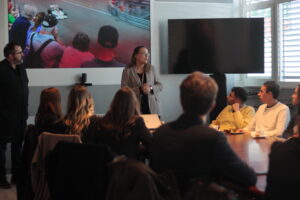
As part of the Digital Marketing specialisation, Nicolas Latour delivers an immersive learning experience:
“We are not training technicians; we are developing decision-makers who understand how AI is transforming their profession. Marketing is becoming AI-driven, and tools such as data analytics, augmented reality and generative AI must become part of every manager’s toolkit.”
His module begins by introducing students to AI from a broader strategic perspective before exploring practical applications, regulatory challenges (GDPR and the AI Act), and environmental considerations.
“The aim is not to promote AI uncritically, but to enable students to make informed decisions within an ethical and responsible framework.”
Data, Decision-Making and AI: A Module for Every Manager
From 2026, Sabrine Mallek will deliver a cross-disciplinary module for Executive MBA participants entitled Data, Methods and Decision-Making. Its objective is to equip managers with the skills to analyse data and use AI confidently—without requiring technical expertise.
“Participants will work on real-life business cases using a collaborative, no-code approach. The aim is to develop analytical thinking, learn how to interpret data effectively and make well-founded decisions.”
The module also places a strong emphasis on ethics and critical thinking.
“AI should never be used without careful consideration. We will explore algorithmic bias, data protection, and the environmental and societal impacts of artificial intelligence.”
Developing Informed Leaders, Not Technicians
Both lecturers share a common vision: artificial intelligence is transforming every function within the organisation. It calls for a new approach to leadership—one that is more analytical, more responsible and more strategic.
“Our graduates must remain relevant in an increasingly automated world. AI is transforming leadership styles, decision-making processes and customer expectations. We need to develop leaders who can approach innovation with awareness, responsibility and critical thinking.”– Nicolas Latour

“AI is a powerful tool, but it must always remain in the service of people. Our role is to foster a critical, ethical and practical understanding of its use.”– Sabrine Mallek