

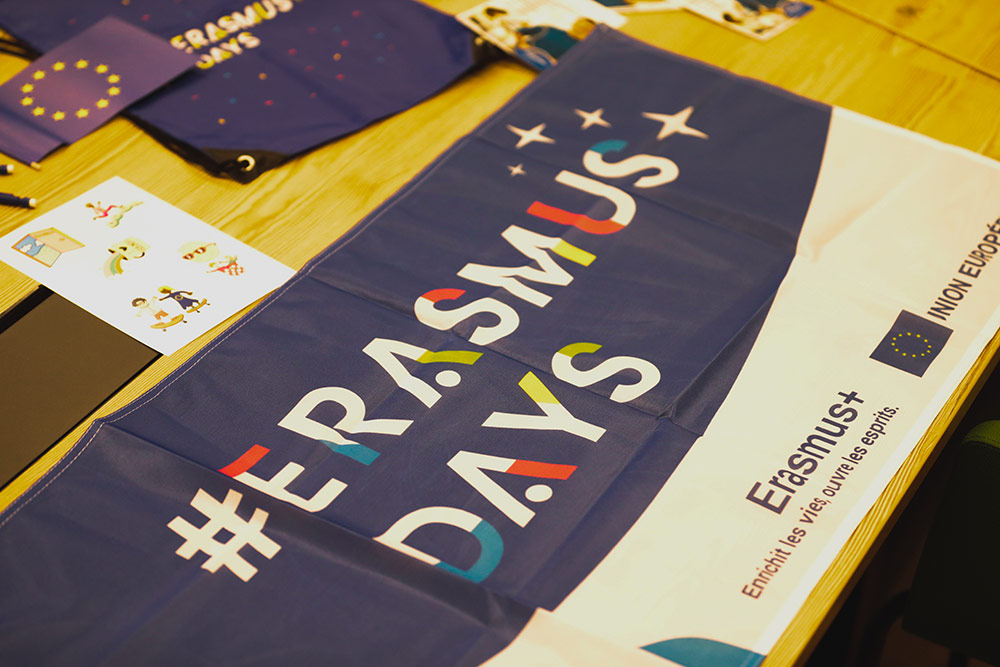
The Erasmus+ programme offers students, staff and teachers the opportunity to take part in study, internship, training or teaching exchanges. ICN Business School holds the Erasmus+ Charter for Higher Education.

The Erasmus+ programme for higher education contributes to the creation of a European Higher Education Area by pursuing several objectives, including:
These experiences enable our students to enhance their language skills and develop transferable skills, thereby boosting their employability in the national, European and international job markets. Furthermore, this programme provides access to these study abroad opportunities at a lower cost, thanks to tuition-free exchange agreements and the availability of a grant.
The Erasmus+ programme encourages mobility throughout Europe for students, teaching and administrative staff.
ICN Business School is part of this ambitious initiative and is involved in the programme’s various activities: Student mobility for studies or traineeship, and staff mobility for teaching or training.
The Erasmus+ programme for the period 2021–2027 highlights new priorities: inclusion, green mobility and digitalisation.
Inclusion is one of the key priorities of the new Erasmus+ programme. It aims to provide educational and mobility opportunities to a wider and more diverse audience by removing socio-economic barriers and promoting access for people from disadvantaged backgrounds, people with disabilities and minority groups. Educational institutions and partner organisations are encouraged to design specific projects that take into account the special needs of these groups, thereby enabling them to fully benefit from the advantages of Erasmus+.
The new programme aims to promote equal opportunities and equal access, inclusion, diversity and equity across all its actions. Organisations and participants with fewer opportunities are central to the Erasmus+ 2021–2027 programme, which provides them with specific mechanisms and resources. When designing their projects and activities, organisations should adopt an inclusive approach to make these projects and activities accessible to a diverse range of participants.
This priority aims to substantially increase the participation of people ‘with fewer opportunities’.
The Erasmus+ programme identifies eight barriers that characterise these participants:
The environment and climate action are priorities for the EU, both now and in the future. Communication on the European Green Deal sets out the new European growth strategy and recognises the crucial role of schools, training institutions and universities in engaging with students, parents and the wider community on the changes needed for a successful transition to achieve climate neutrality by 2050.
In the current context of the climate crisis, green mobility has therefore become a key priority of the Erasmus+ programme for 2021–2027. The aim is to reduce the carbon footprint associated with participants’ travel as part of Erasmus+ projects. To achieve this, the programme actively encourages the use of more environmentally friendly modes of transportation, such as trains or carpooling, and promotes the development of training courses and projects related to sustainability and environmental awareness. In this way, Erasmus+ contributes to building a more environmentally friendly Europe committed to combating climate change.
This priority covers three main areas, covering both mobility schemes and cooperation projects.
Axis 1: Education for Sustainable Development
This is the key focus of this priority, in line with the educational objective of Erasmus+. Mobility schemes will enable participants to gain knowledge about environmental issues and become genuine agents of change (for example, conserving resources, reducing energy consumption, waste and carbon footprint, opting for sustainable food and transport choices, etc.).
Axis 2: Environmental Responsibility
Environmental responsibility aims to reduce the environmental impact of activities linked to Erasmus+ projects:
Axis 3: Developing new skills and new professions
Mobility schemes and the programme’s cooperation initiatives (partnerships, alliances, etc.) should help to develop the skills of beneficiaries in relation to the green transition (for example, by establishing work placement opportunities in the fields of renewable energy, agroecology, or more generally in companies with a strong CSR policy, etc.) or by designing training modules or courses that respond to this shift (for example, training in energy-efficient building renovation or eco-responsible tourism, etc.)
The COVID-19 pandemic has further highlighted the importance of digital education for the digital transformation that Europe needs. In particular, it has underscored the growing need to harness the potential of digital technologies for teaching and learning and to develop digital skills for all. In line with the strategic priorities of the Digital Education Action Plan (2021–2027), the programme aims to support this initiative, which seeks to engage learners, educators, youth workers, young people and organisations in the digital transformation process.
Erasmus Without Paper is a digital initiative under the Erasmus+ 2021–2027 programme. Its aim is to simplify and modernise the administrative procedures related to the mobility of students, teachers and staff across all participating higher education institutions. By switching to digital processes, EWP facilitates the management of applications, inter-institutional agreements, academic recognition and mobility reports, thereby offering a smoother and more efficient experience for all stakeholders. This initiative also promotes faster and more transparent communication between institutions, thereby strengthening international cooperation and exchanges in the field of education.
In conclusion, the new priorities of the Erasmus+ programme for 2021–2027 focus on inclusion, green mobility and digitalisation. These strategic priorities aim to make the Erasmus+ programme even more open, equitable and environmentally friendly, whilst streamlining administrative procedures through the use of innovative digital tools. These developments demonstrate the European Union’s ongoing commitment to education, training and international mobility, with a view to strengthening social cohesion and preparing younger generations to meet the challenges of the future.
Erasmus+ also supports people with disabilities.
Everything you need to know about the Erasmus+ programme.
As part of your course at ICN Business School and in order to obtain your degree, you must complete an international experience, either through an academic exchange at a foreign university or an internship abroad; this is known as the ‘international quitus’.
The Erasmus+ programme can help you fund all or part of your mobility within Europe.
To check your eligibility, we invite you to contact the International Relations Office for academic exchange opportunities and the Careers and Internships Office for internships. Grants are awarded depending on the funds available and subject to the following conditions:
An academic exchange leads to the recognition of ECTS credits earned for progression to the next year (30 ECTS credits per semester). An internship/work placement awards ECTS credits in accordance with the examination regulations.
Blended mobility, as proposed in the Erasmus+ programme, is defined as ‘short-term physical mobility lasting between 5 and 30 days, combined with a virtual component that facilitates exchange and teamwork in the context of collaborative distance learning’.
Virtual activities can take place prior to physical mobility (as preparation for physical mobility) but also afterwards (for supplementary learning and/or to consolidate what has been learnt).
In higher education, it is possible to organise a ‘blended intensive programme’ (also known as a ‘BIP’). This is a short training programme, forming part of the curriculum, designed between three higher education institutions from three countries participating fully in the Erasmus+ programme. This type of project must include blended mobility with the same implementation and recognition arrangements.
Find out the monthly fees for the 2025–2026 academic year. Fees are reviewed annually based on the amount of funding allocated to the institution.
Countries participating in the programme with a high cost of living
Denmark, Finland, Iceland, Ireland, Liechtenstein, Luxembourg, Norway, Sweden, United Kingdom (subject to conditions), Switzerland, Germany, Austria, Belgium, France, Italy, Netherlands
Study mobility: €400 (per month)
Internship mobility: €550 (per month)
Countries participating in the programme with an average cost of living
Cyprus, Spain, Greece, Malta, Portugal, Estonia, Latvia, the Czech Republic, Slovakia, Slovenia.
Study mobility: €350 (per month)
Internship mobility: €500 (per month)
Countries participating in the Programme with a low cost of living
North Macedonia, Bulgaria, Croatia, Hungary, Lithuania, Poland, Romania, Serbia, Turkey.
Study mobility: €350 (per month)
Internship mobility: €500 (per month)